
Seminole Projected and Actual Release
A projected date is a current calculation. An actual release is a completed custody event. FDC labels the public estimate on a current state-inmate detail Current Release Date. Florida Statute section 944.275 calls the Department’s legal calculation the tentative release date. Preserve the public label when citing the screen, and describe it as FDC’s current projection while the status remains incarcerated.
Four dates are often confused. The sentence date records when judgment was imposed. The effective sentence date and credited custody affect the calculation. A projected release date estimates when the controlling term may end. The physical release timestamp records when the custodian completed the exit or transfer. Writing down each label prevents a court date or estimate from being passed along as the actual event.
After state release, use the Inmate Release Information Search. A past Release Date and a completed Date Out-Custody in the release dataset establish the later event far better than an old projection. For John E. Polk, request the physical release timestamp, type or code, and destination. A jail exit to FDC, USMS, ICE, or another facility remains custody even though the county episode ended.
| Record | What the date means | What confirms release |
|---|---|---|
| FDC Current Release Date | Present state-prison projection | FDC released-inmate record after departure |
| John E. Polk calculation | Operational estimate for a county sentence | SCSO physical release event and destination |
| Court order or sentence end | Legal authority or term, subject to processing and holds | Custodian’s completed release record |
| FCOR hearing or presumptive date | Commission milestone that may remain conditional | Final order plus updated FDC release record |
Find a Seminole Projected Release Date
Start by deciding whether the person is in the Seminole County jail, Florida state prison, federal custody, or another system. The FDC Corrections Offender Network is statewide. It is not an archive for a brief John E. Polk stay. Search by DC number whenever possible. If using a name, compare date of birth, aliases, photo, offenses, and county of commitment.
- Check current custody and identify the agency. Do not infer the custodian solely from where the arrest began.
- For an FDC inmate, open Inmate Population Information and record the exact Current Release Date label, status, and capture date.
- For a John E. Polk sentence, read the judgment for sentence length and jail credit, then ask SCSO for its sentence calculation and release record.
- For a pretrial case, review the Seminole Clerk docket for bond, pretrial release, dismissal, plea, sentence, warrants, and holds.
- Check detainers, consecutive cases, amended judgments, and receiving-agency facts before treating any date as community release.
- After the event, switch to the released-person dataset and supervision search to verify departure and any remaining oversight.
The official FDC search menu separates current inmates, released inmates, and supervised people.
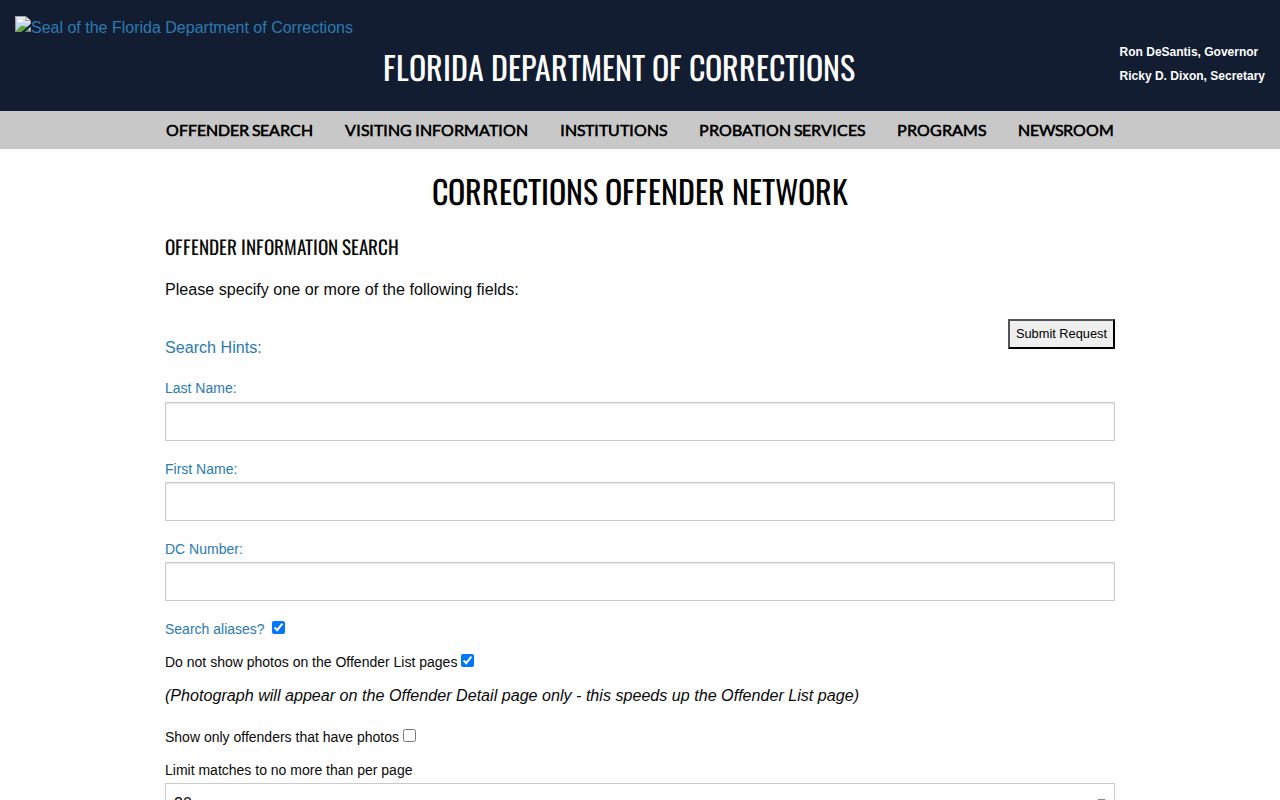
Selecting the correct population prevents a county-only jail stay from being mistaken for a state-prison record.
Read Seminole FDC Release Fields
The current state record may show a DC number, custody location, offense and sentence data, detainers, and Current Release Date. Some records display TO BE SET. That wording is not a release denial and should not be replaced with a guessed date. It means the public screen does not yet supply a usable projection.
The released-offender dataset serves a different purpose. It can preserve release date, release type, photo, sentence history, and Date Out-Custody after an FDC episode. A person can be released from prison while still under probation, parole, conditional release, or another form of supervision. Physical release and final discharge are separate findings.
| Field | How to use it | Limit |
|---|---|---|
| DC number | Match the state corrections identity | Does not cover county-only custody |
| Current Location | Identify the present FDC institution or office | Can change after movement |
| Current Release Date | Quote with status and capture date | Projected, not guaranteed |
| Detainers | Check whether another authority may receive the person | Public detail may not explain every operational hold |
| Release Date and Date Out-Custody | Confirm a completed FDC release episode | Does not prove all supervision ended |
The FDC inmate search shows the entry point for a current prisoner and the public release-date terminology.
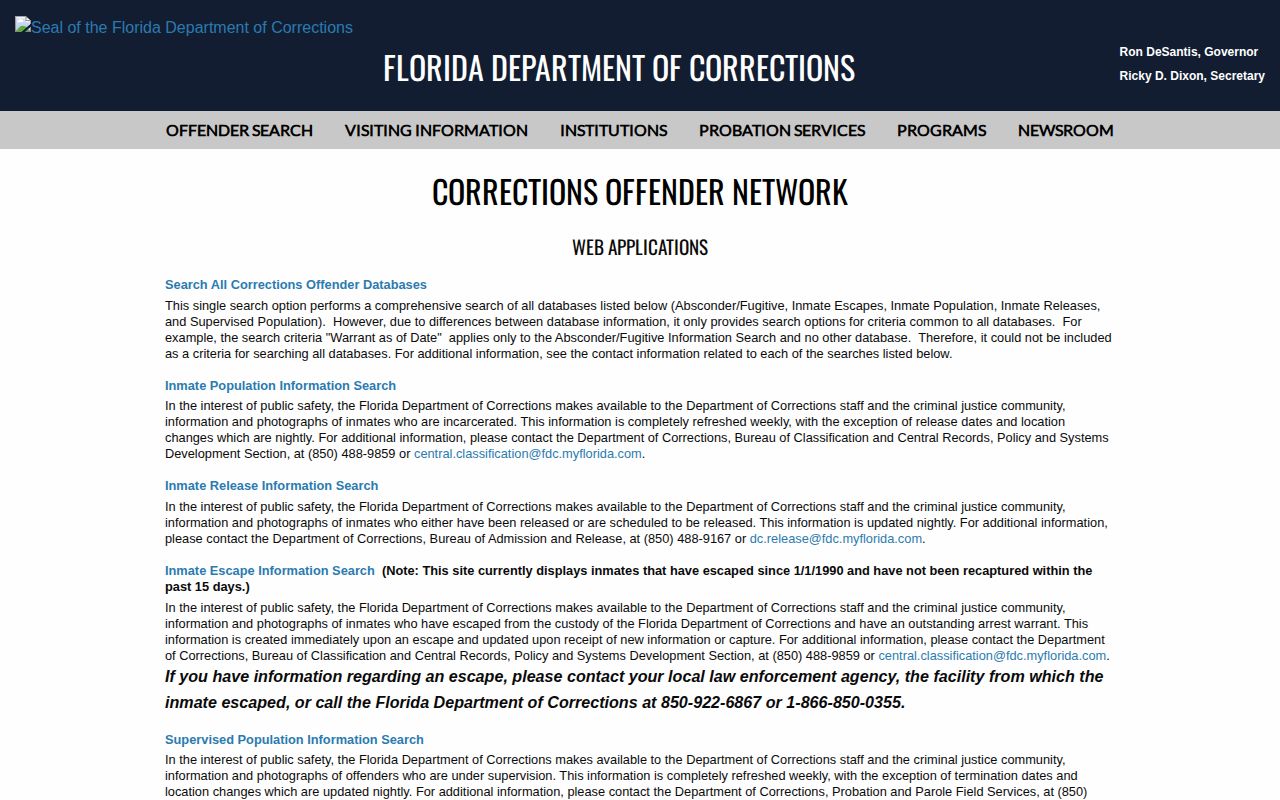
The live detail should be checked again whenever a decision depends on a date because awards, forfeitures, orders, or new sentence data may alter it.
How Florida Calculates Seminole Dates
The starting point is the sentence imposed by the court. FDC accounts for the effective date, legally applied jail or prison credit, concurrent or consecutive terms, and any controlling minimum term. It then applies gain-time categories allowed for the offense and offense date. Gain-time is credit that can reduce time served under the governing law. Awards are not automatic merely because a statute sets a maximum.
Corrections to sentencing papers or jail credit can change the calculation. So can a new sentence, disciplinary gain-time forfeiture, restoration, court order, detainer, or release-program decision. A person with two concurrent sentences may have a different controlling date than a person with consecutive sentences, which run one after the other. Mandatory minimum terms and offense-specific limits must also be read before any estimate is made.
A detainer is a notice that another authority may want custody when the current term ends. It may not change the arithmetic shown for the prison sentence, yet it can change where the person goes on that date. That is why the projected end of FDC custody should not be described as a promised return home. The release type, destination, and any receiving record complete the picture.
| Change | Possible effect on date | Best record |
|---|---|---|
| Corrected jail credit | Moves the calculation after amended credit is applied | Judgment/order and updated FDC record |
| Gain-time award or restoration | May move a tentative date earlier within legal limits | FDC calculation history |
| Gain-time forfeiture | May move the date later | FDC record and disciplinary action |
| New or consecutive sentence | Can create a later controlling end date | Court judgments and FDC sentence history |
| Detainer or hold | May send the person to another custodian instead of home | Custody and receiving-agency records |
| FCOR action | May set or alter a conditional release milestone | Final Commission order |
Seminole Release and the 85 Percent Floor
Florida Statute section 944.275(4)(f) sets a truth-in-sentencing floor for offenses committed on or after October 1, 1995. Gain-time may not cause a prisoner in that cohort to serve less than 85 percent of the sentence imposed. That rule is a floor, not a stand-alone formula for announcing a release day.
Jail credit, consecutive cases, mandatory terms, offenses that limit gain-time, forfeiture, and later sentence changes still matter. Older offenses fall under older statutes and gain-time categories. The research identifies date-based monthly ceilings for older cohorts and up to ten days per month for the post-October 1995 cohort, with statutory exclusions and limited other awards. Those are eligibility limits, not guaranteed credit.
Parole should not be used as another name for gain-time. Florida parole generally applies to a narrow legacy group and limited later categories. FCOR eligibility turns on offense date and statutory class, while FDC performs the sentence and gain-time calculation for state custody.
Note: Multiplying a sentence by 0.85 cannot account for jail credit, consecutive terms, exclusions, forfeitures, holds, or later court orders.
Seminole County Jail Date Rules
FDC’s Current Release Date does not govern a sentence served only at John E. Polk. Florida Statute section 951.21 supplies county gain-time authority, while the Sheriff maintains the operational calculation. A focused request should identify the judgment, total term, jail credit, gain-time awarded or forfeited, any holds, the projected date, and the eventual release event.
Section 951.21 permits, when local policy authorizes it and no misconduct charge is sustained, up to five days per month in years one and two, ten days in years three and four, and fifteen days in year five and later. It also permits up to five additional days monthly for qualifying meritorious conduct if locally adopted. Escape or serious misconduct can forfeit accrued time. No official Seminole policy confirming which optional credits are currently applied was found, so those statutory maximums cannot be treated as an individual John E. Polk calculation.
No verified Seminole source promises a Friday release when an end date falls on a weekend or holiday. Nor does an official source promise a midnight exit. Before community release, staff must also check warrants, holds, and any receiving agency. Call John E. Polk at 407-665-1200 before planning around an estimate.
When Seminole Dates Say To Be Set
The public FDC example marked TO BE SET shows why blank or unset values must be reported exactly. It may reflect a calculation or legal issue that the public screen cannot yet resolve. It does not authorize a reader to use the sentencing date, hearing date, or an arithmetic shortcut as a substitute.
The official FDC field example displays the Current Release Date label and its change warning.
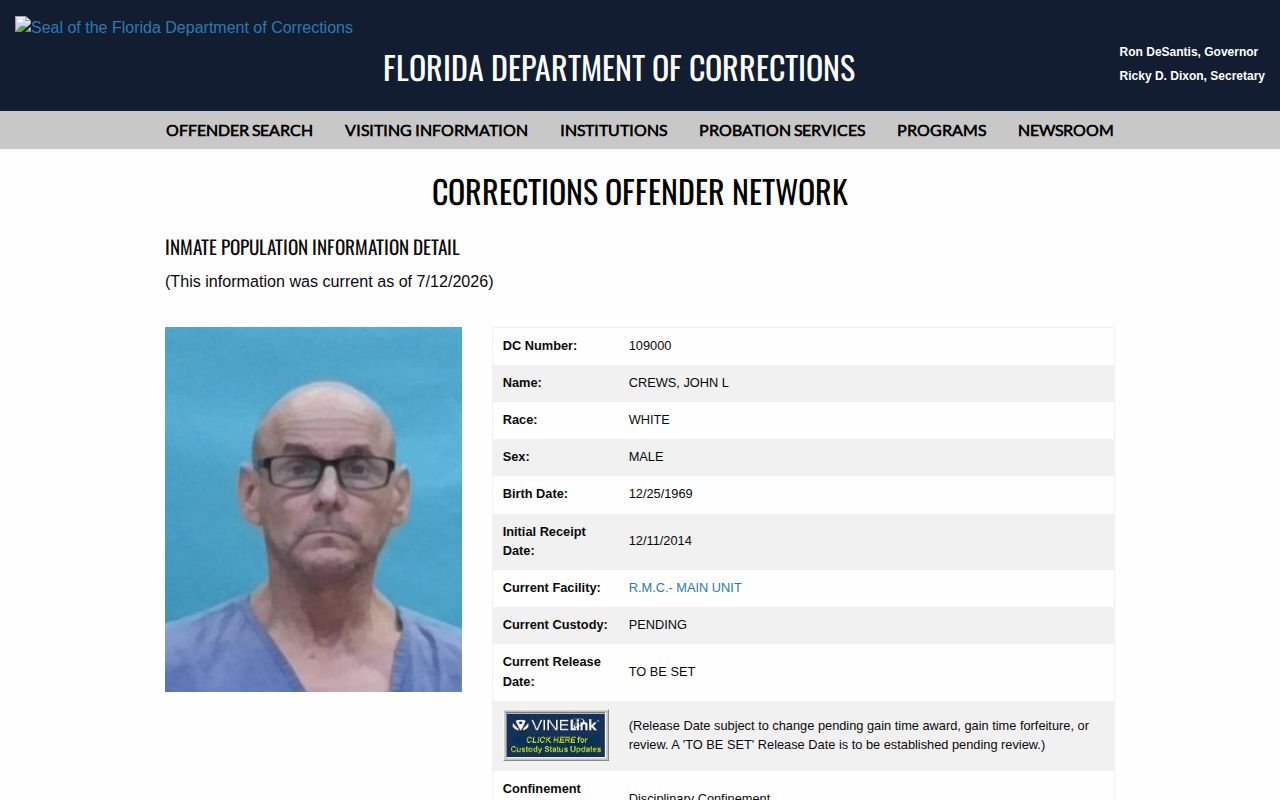
The useful evidence is the label and warning. Unneeded personal details from an example record should not be repeated.
If the displayed date has passed while status still says incarcerated, do not announce release. Contact FDC, look for new cases or detainers, and wait for a completed release record. A VINE alert can provide a prompt to recheck, but the Seminole County VINELink check is notification rather than certification.
For a formal calculation question, provide the DC number and ask FDC’s Bureau of Admission and Release about the displayed date, sentence inputs, and any public calculation history. The bureau is listed at 850-488-9167 and dc.release@fdc.myflorida.com. A focused question is more useful than asking staff to predict every event that could affect a future date.
Seminole Pretrial Cases Lack Set Dates
A pretrial detainee often has no sentence-based projected release date. The next court event, bond amount, or pretrial-release review is not the same as a guaranteed exit time. Search the Seminole Clerk docket for the actual order, then confirm that Booking received it and cleared other cases or holds.
A court order can authorize release while processing remains incomplete. Conversely, a jail exit can be a transfer to FDC or another authority. The complete Seminole County custody and release-record workflow is described on the Seminole County released inmates search page. For a precise claim, pair the court authority with the physical event and destination.